Heaviest Black Hole Ever Detected Discovered
Astronomers discovered the heaviest black hole ever detected, estimated at 36 billion times the Sun's mass, located in the Cosmic Horseshoe galaxy 5 billion light-years away.




Overview
Researchers have successfully identified the heaviest black hole ever detected, marking a significant astronomical discovery that pushes the boundaries of known cosmic structures.
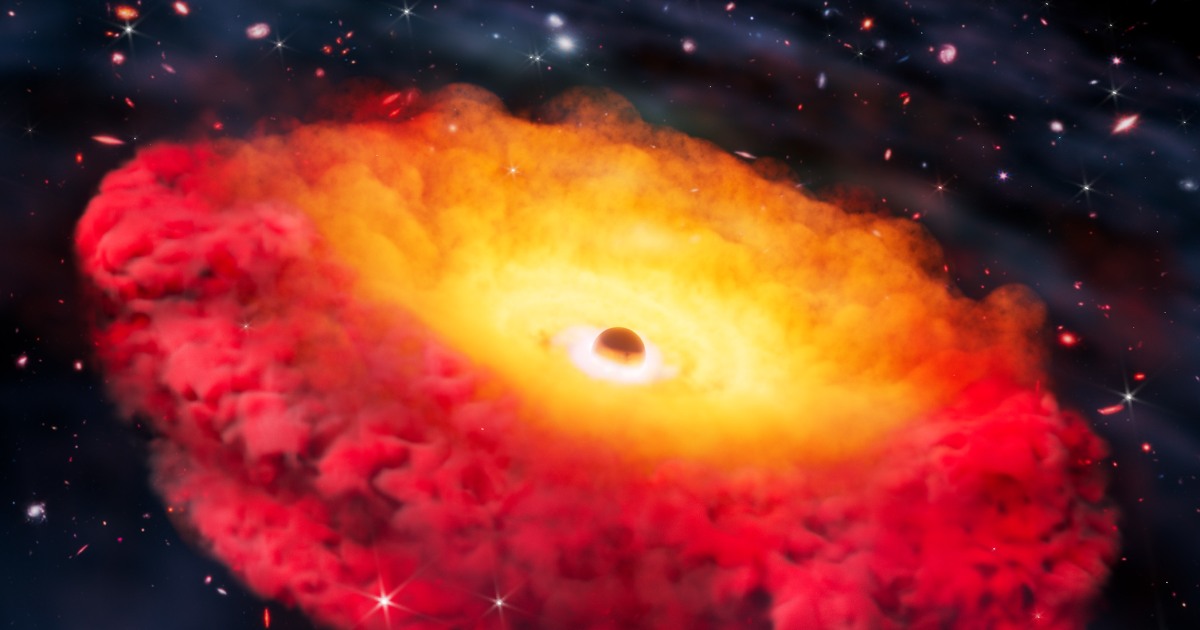
This newly discovered black hole is estimated to possess an immense mass, reaching up to 36 billion times that of our Sun, making it a colossal entity in the universe.
The colossal black hole is situated within the supermassive galaxy known as Cosmic Horseshoe, providing a specific location for this extraordinary celestial body.
Its immense distance from Earth is approximately 5 billion light-years, highlighting the vast scale of the universe and the advanced capabilities of current astronomical observation.
For perspective, this black hole is roughly 10,000 times heavier than the supermassive black hole found at the center of our own Milky Way galaxy.
Analysis
Center-leaning sources frame this story by emphasizing the awe-inspiring and groundbreaking nature of the scientific discovery. They use evocative language to highlight the black hole's immense size and its proximity to theoretical limits, creating a narrative of scientific wonder and progress. The collective editorial choices aim to convey excitement about new astronomical findings and the advancement of research methods.
FAQ
The mass was measured by combining stellar kinematics—tracking the movements of stars around the black hole—with gravitational lensing, where the black hole's gravity bends and magnifies light from background objects, allowing precise estimation of its mass.
This black hole is approximately 36 billion times the mass of the Sun, making it about 10,000 times heavier than the supermassive black hole at the center of the Milky Way galaxy.
The Cosmic Horseshoe galaxy's immense mass causes a gravitational lensing effect that distorts light into a horseshoe shape, which aids in detecting and measuring the central black hole's mass with higher precision.
The Cosmic Horseshoe galaxy is approximately 5 billion light-years away from Earth.
The discovery suggests that ultramassive black holes may form through the merging of multiple black holes from companion galaxies, indicating the end stage of galaxy and black hole formation and co-evolution in massive galaxies.