Venezuela Acting President Signs Law Opening Oil Sector To Private Firms
Delcy Rodríguez signs reform allowing private management of oilfields and capping royalties at 30%, amid U.S. sanction easings.
 PBS NewsHour
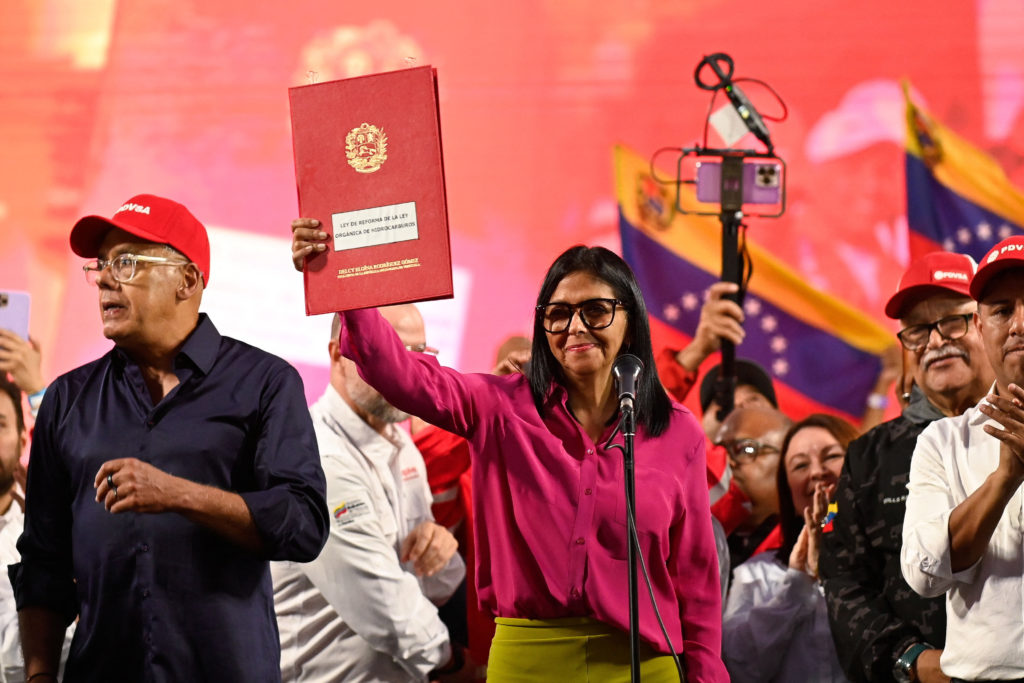
Venezuela’s acting president signs overhaul easing state control of oil industry into law

 CNN
CNNVenezuelan lawmakers approve new law opening oil industry to foreign companies
 Epoch Times
Venezuela Approves Oil Law Reform to Ease State’s Grip and Lure Private Investors

 Al Jazeera
Venezuela’s Rodriguez signs oil reform law while the US eases sanctions
Overview
Acting President Delcy Rodríguez signed a law on Jan. 29 opening Venezuela’s oil sector to private companies and allowing independent arbitration, records show.
The National Assembly approved the Hydrocarbons Law overhaul earlier on Jan. 29 to reverse two decades of state control and attract foreign investment amid production declines, legislative records show.
The U.S. Treasury on Jan. 29 issued a general license easing some sanctions and authorizing certain transactions by U.S. energy firms, a move that officials said aims to facilitate investment while banning entities from China, Russia, Iran, North Korea or Cuba.
Opposition lawmaker Antonio Ecarri urged adding transparency and accountability measures, including a public website for funding, while ruling-party lawmaker Orlando Camacho said the reform "will change the country's economy," assembly transcripts show.
Analysts say the law could prompt return of foreign companies but noted outstanding arbitration claims from firms like ExxonMobil and ConocoPhillips and cautioned that legal, security and political risks remain.
Analysis
Center-leaning sources frame the law as a market-oriented pivot and geopolitical shift, emphasizing privatization and U.S. sanction relief. Editorial choices — loaded terms ('brazen seizure', 'reversing a tenet'), selective emphasis on investor assurances and sanctions' harm — prioritize economic reform narratives, while quoting officials and workers as source content illustrating reactions.
FAQ
The law allows private companies to manage oilfields, market their share of production directly, lease PDVSA assets, cap royalties at 30% (reducible to 15-20% for certain deposits), and permits independent arbitration for disputes.
The US Treasury issued a general license on Jan. 29 easing some sanctions, authorizing certain transactions by US energy firms, while banning entities from China, Russia, Iran, North Korea, or Cuba.
Analysts note outstanding arbitration claims from ExxonMobil and ConocoPhillips, plus legal, security, and political risks; opposition calls for transparency measures like a public funding website.
The National Assembly approved the overhaul on Jan. 29, and Acting President Delcy Rodríguez signed it on the same day.
