Trump Praises Jesse Jackson While Jabbing Obama
Mr. Trump posted on Truth Social on Feb. 17 calling Jackson a 'force of nature' and saying Jackson 'could not stand' Barack Obama after Jackson's death at 84.
 Western Journal
Trump Shares Tribute to Jesse Jackson, Who 'Could Not Stand' Obama

 Chicago Tribune
President Trump praises late Rev. Jesse Jackson as ‘good man,’ claims he disliked Barack Obama

 Rolling Stone
Trump Uses Jesse Jackson's Death to Attack Democrats

 New York Daily News
Trump praises late Rev. Jackson as ‘good man,’ claims he disliked Obama
Overview
President Donald Trump posted on Truth Social on Feb. 17 calling the Rev. Jesse Jackson a "force of nature" and a "good man" while saying Jackson "could not stand" Barack Obama.
Jackson died at 84, his family said he died peacefully Tuesday morning after being diagnosed last year with a rare neurodegenerative condition and being hospitalized in November for observation.
Rep. Hakeem Jeffries called Jackson "the people's champion," Bernice King posted a photo of Jackson with her father captioned "Both ancestors," and Mayor Zohran Mamdani urged honoring him "in struggle."
Trump said he provided office space to Rainbow PUSH and cited criminal justice reform, Opportunity Zones and the FUTURE Act, which he said provides more than $255 million a year to HBCUs.
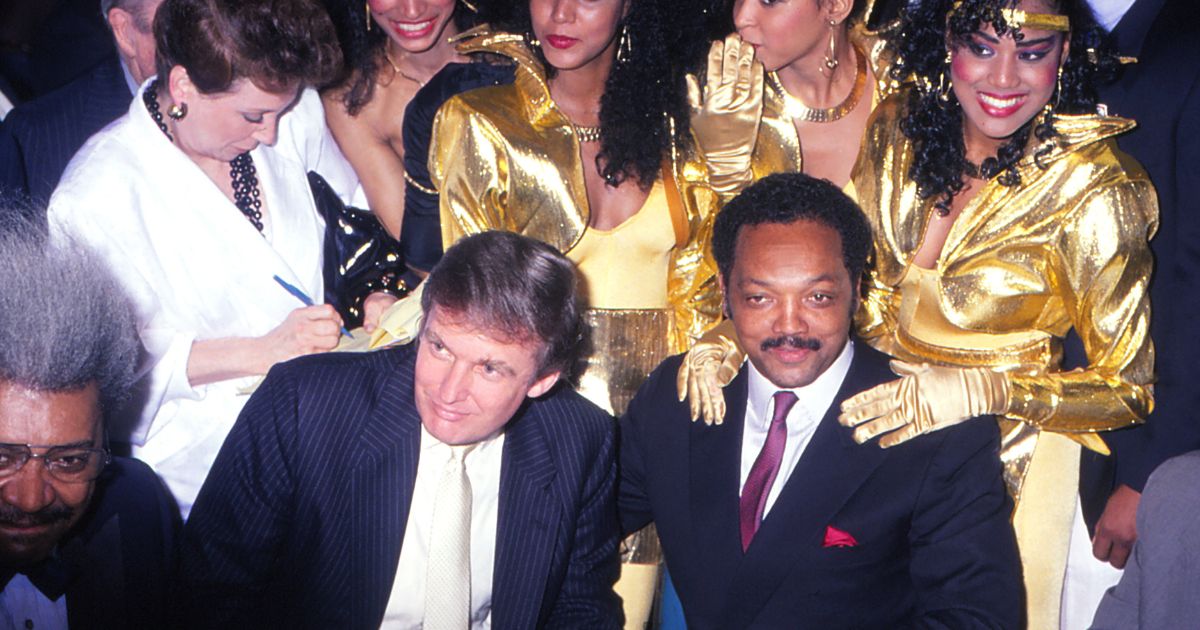
Jackson and Trump appeared together in 1988 and Jackson introduced Trump at conferences in January 1998 and 1999, and the White House later removed the Truth Social post after more than 12 hours online.
Analysis
Center-leaning sources frame Jackson’s death by foregrounding President Trump’s contradictory tribute—using evaluative wording such as "petty digs"—then juxtaposing that with reverent tributes. Editorial choices spotlight Trump’s social‑media "couldn’t stand" line and prioritize quotes from Democratic figures, emphasizing conflict and reaction over deep biographical context.
FAQ
Jackson's 1984 and 1988 presidential campaigns were groundbreaking efforts that registered millions of first-time voters and received widespread national support on a progressive platform.[3] These campaigns fundamentally reshaped American politics by constructing the Rainbow Coalition, an alliance bringing together African Americans, Latinos, labour unions, progressive whites, and other marginalized communities.[2] Historians note that Jackson's electoral architecture sketched twenty years earlier provided the intellectual foundation for Barack Obama's 2008 coalition, demonstrating how Jackson transformed civil rights activism into a pathway toward electoral power and reshaped Democratic Party coalition-building strategies.[4]
Jackson and Obama represented different generations of Black political leadership with contrasting philosophical approaches.[1] Jackson's politics were rooted in prophetic confrontation and direct engagement with power through leverage and negotiation, while Obama focused more on coalition building and reconciliation.[1][2] This philosophical divide became public in 2008 when Jackson was caught on a hot microphone criticizing Obama for "talking down to Black people," revealing deeper tensions about how to approach racial justice and political strategy.[2] Despite this disagreement, Jackson's earlier work had paved the way for Obama's eventual election as president.[1]
Operation PUSH was Jackson's attempt to translate street-level outrage into negotiating power following Martin Luther King Jr.'s assassination in 1968.[1] Rather than replacing King, Jackson refused to let the civil rights movement fade by transforming protest into organization.[1] Through Operation PUSH and his broader advocacy, Jackson worked to create leverage for change, understanding from his own childhood in a deeply segregated southern community what systemic changes were needed.[1] His efforts ultimately demonstrated how activism could evolve into pathways toward electoral and institutional power.
Born in Greenville, North Carolina to a single teenage mother, Jackson grew up in a deeply segregated southern community, which profoundly influenced his understanding of systemic inequality.[1] He first entered national consciousness as a young aide to Martin Luther King Jr., witnessing King's assassination at close quarters in 1968.[1] These formative experiences of hardship and the traumatic loss of King shaped Jackson's determination to translate personal understanding of marginalization into organized action and negotiating power.[1] His childhood experiences directly informed his later work with Operation PUSH and the Rainbow Coalition, which specifically aimed to give voice to communities he had grown up among.
Beyond U.S. civil rights, Jackson was an outspoken international advocate who negotiated the release of hostages in Syria, Iraq, Kuwait, and Kosovo, was a critic of apartheid, and championed Palestinian rights.[3] His commitment to international justice reflected his belief that moral principles extended beyond American borders. In his presidential campaigns, Jackson advocated for a two-state solution in the Middle East and championed causes like freeing Nelson Mandela, positioning these as moral imperatives rather than merely political positions.[5]
