Appeals Court Allows Ten Commandments Posters In Louisiana Classrooms
5th Circuit voted 12-6 to lift a block on a 2024 Louisiana law requiring 11x14 Ten Commandments posters in every public school classroom.

 The Guardian
Louisiana schools can display Ten Commandments, appeals court rules
 NPR
NPRCourt clears way for Louisiana law requiring Ten Commandments in classrooms to take effect

 NBC News
Ten Commandments can be displayed in Louisiana classrooms, appeals court rules
 CBS News
Appeals court clears way for Louisiana law requiring public schools to display Ten Commandments
Overview
The 5th U.S. Circuit Court of Appeals voted 12-6 on Friday to lift a preliminary injunction blocking a 2024 Louisiana law requiring poster-sized displays of the Ten Commandments in public school classrooms.
The court said it was too early to rule on the law's constitutionality because key facts remain unknown, including how prominently schools will display the text, whether teachers will reference it, or whether other texts will be included.
Republican Gov. Jeff Landry praised the ruling, and Louisiana Attorney General Liz Murrill said schools should "follow the law" and that her office provided examples of compliant posters.
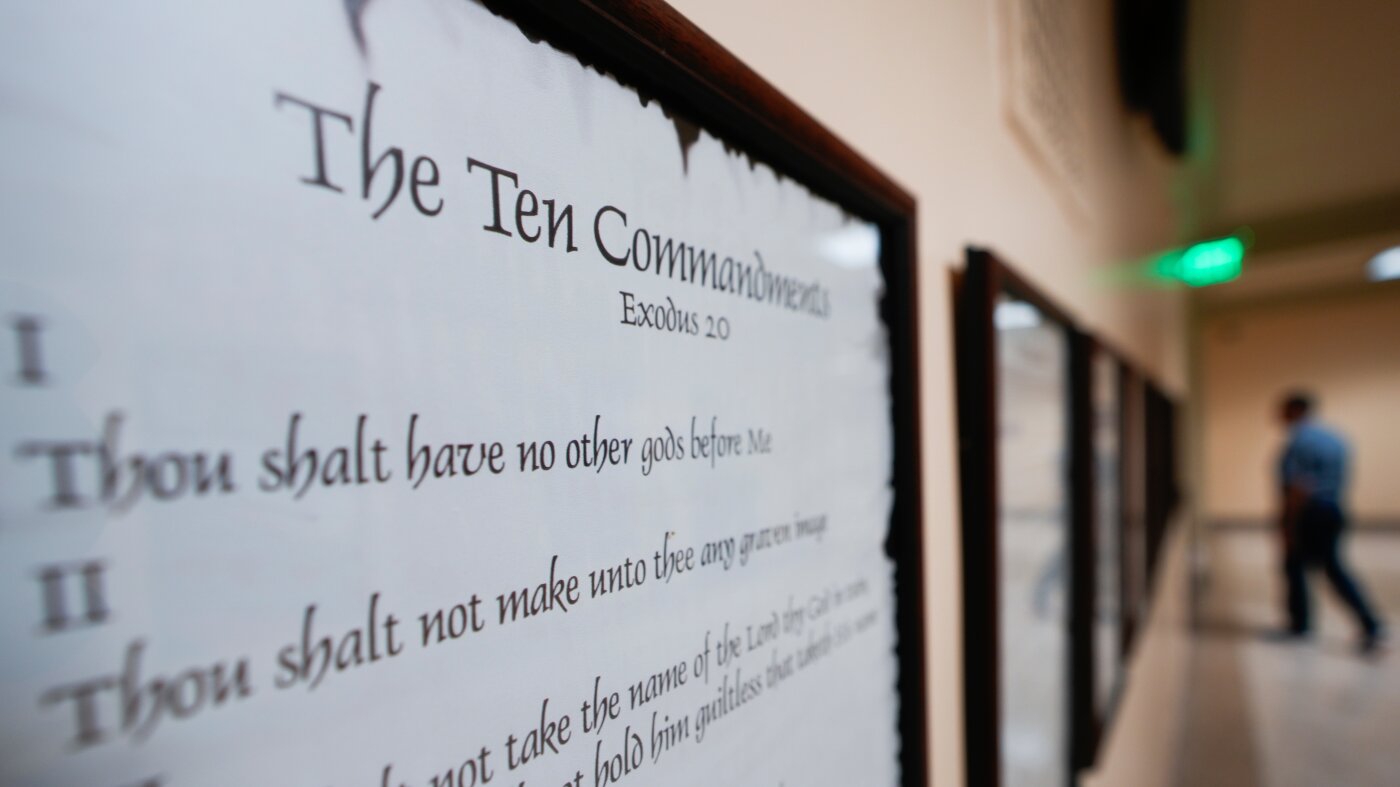
The law requires the Ten Commandments to appear on a poster at least eleven inches by fourteen inches in each public elementary, middle and high school classroom and in college and university classrooms, with the text as the 'central focus'.
The ACLU of Louisiana and the Freedom From Religion Foundation called the ruling "extremely disappointing" and said they will continue pursuing legal challenges to block the law.
Analysis
Center-leaning sources present the case neutrally, focusing on procedural facts (5th Circuit vote, injunction) and including balanced source content: a statement from Louisiana’s attorney general, dissents from judges emphasizing Establishment Clause concerns, and historical Supreme Court precedents. Language is factual rather than loaded, and competing viewpoints are included.
FAQ
The preliminary injunction was likely based on constitutional concerns about the Establishment Clause. The ACLU and other civil rights organizations argued that the law 'violates the separation of church and state and is blatantly unconstitutional.'[1] This argument draws from precedent in Stone v. Graham (1980), where the Supreme Court struck down a similar Kentucky law requiring Ten Commandments postings in public school classrooms, finding it had 'no secular legislative purpose' and was 'plainly religious in nature.'[1]
The 5th Circuit Court of Appeals stated it was 'too early to rule on the law's constitutionality because key facts remain unknown, including how prominently schools will display the text, whether teachers will reference it, or whether other texts will be included.' This suggests the court wanted to see how schools would actually implement the law in practice before making a final constitutional determination.
The Supreme Court's makeup has changed significantly since the 1980 Stone v. Graham decision that struck down Kentucky's similar law.[1] Legal experts suggest it is 'unclear whether the new law will face a similar fate as the Kentucky law in 1980,' indicating that the current conservative-leaning Court may be more receptive to the law than the Court was in 1980.[1]
The law requires that the Ten Commandments be displayed on 'a poster or framed document that is at least eleven (11) inches by fourteen (14) inches,' with the text of the Ten Commandments serving as the 'central focus' of the poster and printed in 'large, easily readable font.'[1] Each school governing authority determines the nature of the display, provided it meets these minimum requirements.[1]
Civil rights organizations including the ACLU of Louisiana and the Freedom From Religion Foundation have stated they will 'continue pursuing legal challenges to block the law' following the 5th Circuit's decision. The case will likely proceed through additional court proceedings, potentially reaching the U.S. Supreme Court for a final constitutional determination.
