Supreme Court Bars Suits Over Intentionally Withheld Mail
In a 5-4 decision, the Court held the FTCA's postal exception bars suits even for intentional nondelivery in a case from Euless, Texas.

 Joe.My.God.
SCOTUS: You Can't Sue For Intentionally Withheld Mail - Joe.My.God.
 Slate
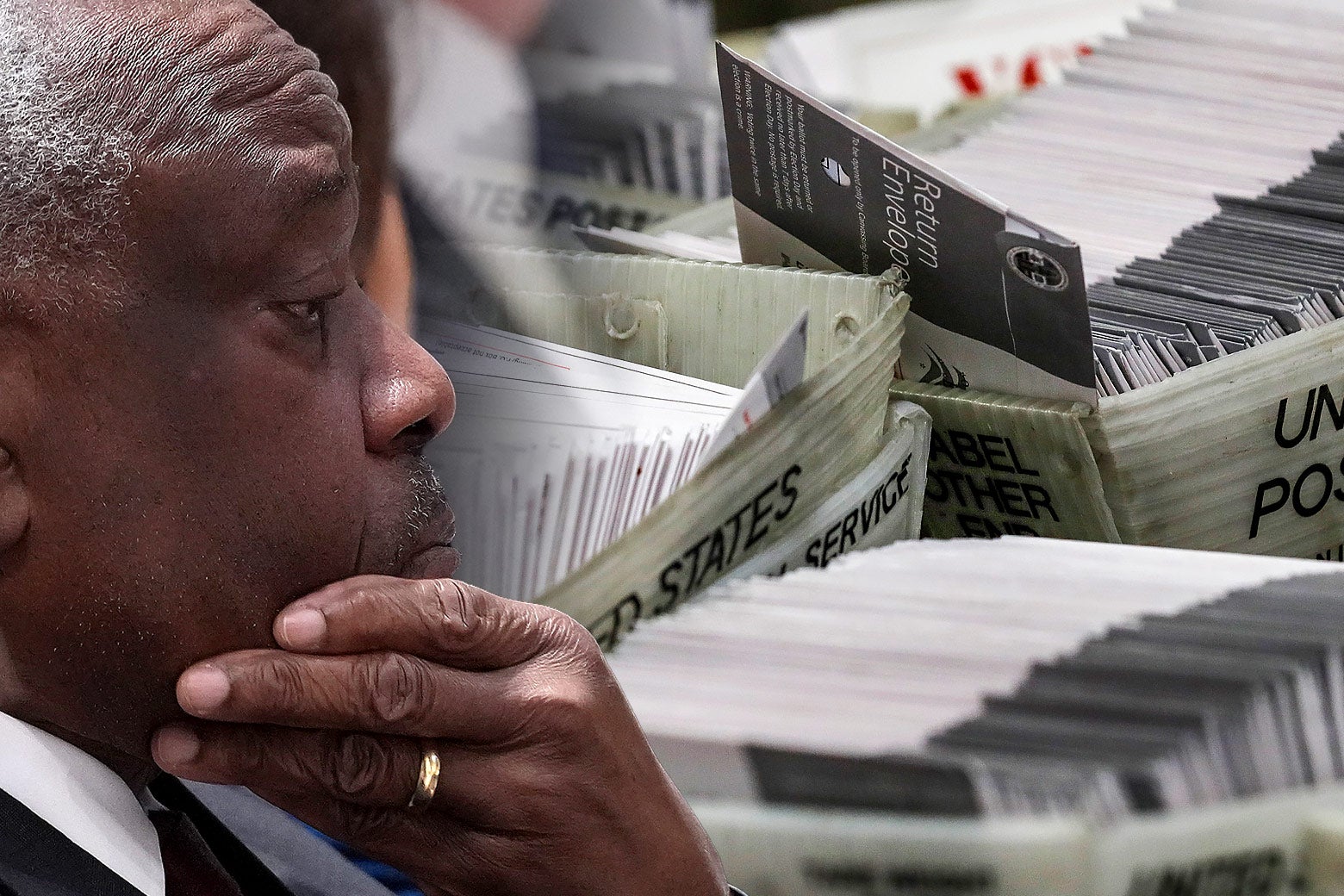
SlateClarence Thomas Just Created a Dangerous New Threat to Mail Voting

 FOX News
Postal Service can't be sued for intentionally not delivering mail, Supreme Court rules in 5-4 split
 ABC News
Supreme Court rules the Postal Service can't be sued, even when mail is intentionally not delivered
Overview
The Supreme Court ruled 5-4 that the Federal Tort Claims Act's postal exception bars lawsuits against the U.S. Postal Service for intentional nondelivery, Justice Clarence Thomas wrote.
The case was brought by Lebene Konan, a Texas landlord who alleges two Euless post office employees withheld her and her tenants' mail for two years and that racial prejudice motivated the conduct.
Justice Sonia Sotomayor dissented, saying the postal exception should not protect malicious intentional nondelivery, and she was joined by Justices Neil Gorsuch, Elena Kagan and Ketanji Brown Jackson.
The Trump administration warned that a ruling for Konan would lead to a flood of similar lawsuits against the cash‑strapped Postal Service.
The Court vacated the Fifth Circuit's ruling and returned the case for further proceedings, leaving unresolved whether all of Konan's claims are barred.
Analysis
Center-leaning sources report this ruling neutrally, relying on court votes and direct descriptions of majority and dissenting opinions, presenting the plaintiff’s allegations (including her race) and the administration’s warning without evaluative language; coverage emphasizes factual chronology and competing legal views rather than advocacy.
FAQ
Lebene Konan, a realtor and landlord in Euless, Texas, alleged that United States Postal Service employees subjected her to a yearslong campaign of racial harassment by intentionally withholding mail from her and her tenants[1]. She claimed that two postal workers refused to deliver mail because they objected to her owning multiple properties and renting them to white people[1]. She sued for damages including lost rental income after frustrated tenants moved away and filed common law tort claims for tortious interference with prospective business relations, intentional infliction of emotional distress, and conversion.
The Fifth Circuit Court of Appeals had held that the postal exception only applied to negligent conduct, not intentional acts, reasoning that "loss" was limited to unintentional misplacement[4]. However, the Supreme Court majority, led by Justice Clarence Thomas, adopted a broader interpretation, holding that the ordinary meaning of "loss" and "miscarriage" encompasses any mail that fails to arrive at its intended destination, regardless of whether the failure was negligent or intentional[5]. Thomas wrote that "a 'miscarriage' includes any failure of mail to arrive properly...regardless of why it happened"[3].
Justice Sonia Sotomayor, joined by Justices Gorsuch, Kagan, and Jackson, argued that the majority's interpretation transformed a narrow exception designed for accidents into a broad shield for intentional misconduct[1]. Sotomayor contended that "loss" and "miscarriage" in the statute plainly denote unintentional conduct and that Congress, by using specificity over generality in listing "loss," "miscarriage," and "negligent transmission," intended the exception to be limited in scope[3]. The majority countered that dictionaries and ordinary usage supported a broader reading that does not depend on the carrier's intent[1].
The Supreme Court vacated the Fifth Circuit's ruling and returned the case for further proceedings[5]. However, the justices did not definitively decide whether all of Konan's claims are barred by the postal exception or which arguments Konan adequately preserved[5]. This means the case will go back to the lower courts to determine the ultimate outcome, though the Supreme Court's ruling establishes that at least some of her claims related to intentional mail nondelivery fall under the postal exception and are barred[5].
The ruling effectively shields the USPS from tort liability for intentional nondelivery of mail under sovereign immunity, which could have significant consequences for individuals who experience deliberate denial of postal services[1][5]. The Trump administration had warned that ruling against the USPS would lead to a flood of similar lawsuits against the financially struggling Postal Service[1]. This decision establishes that the postal exception protects the government even when postal workers intentionally withhold mail, potentially limiting remedies available to citizens who face such misconduct[5].