Tapper Rebukes Leavitt and Hegseth Over Coverage Of Fallen Troops
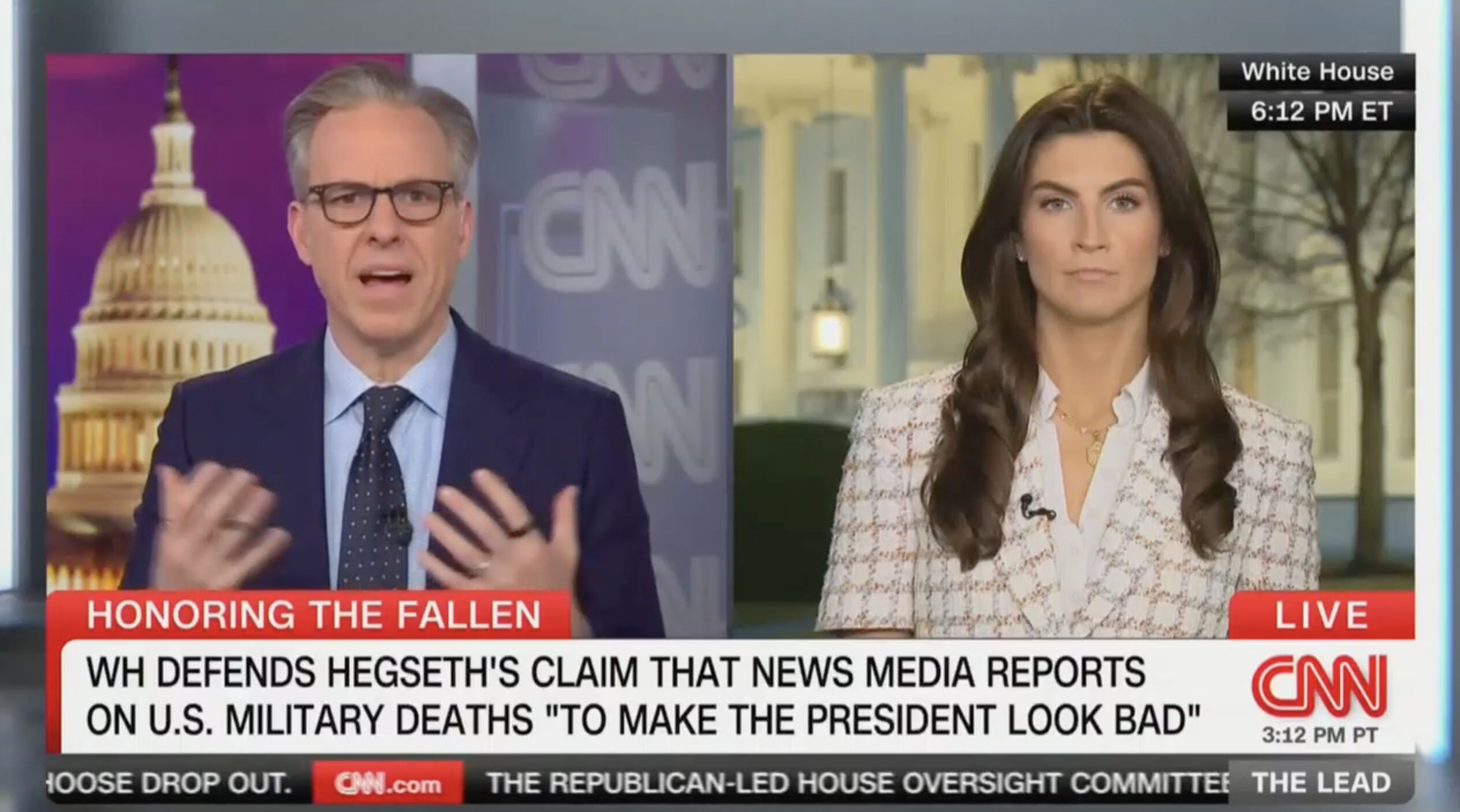
Jake Tapper called Karoline Leavitt and Pete Hegseth's claims that media coverage of U.S. troop deaths was meant to 'make the president look bad' offensive after six service members died following strikes tied to Iran.
 MEDIAite
Tapper Slams Leavitt for Claiming Media Reported Troop Deaths to Damage Trump

 Raw Story
Jake Tapper unloads on Trump officials' 'offensive' remarks: 'Height of narcissism'
 MEDIAite
‘Just Not True’: CNN’s Jake Tapper Blasts Hegseth’s Claim Media Reports Military Deaths Just to Make Trump ‘Look Bad’

 RedState
CNN Wins the 'Fake News' Prize As Karoline Leavitt Tears Apart Their Attempt to Misrepresent Hegseth
Overview
Jake Tapper sharply rebuked White House Press Secretary Karoline Leavitt for claiming media coverage of U.S. troop deaths sought to make President Donald Trump look bad, calling the remarks offensive and "the height of solipsism and narcissism," he said.
The exchange came as six U.S. service members were killed in the aftermath of U.S. and Israeli strikes that included the killing of Iranian Supreme Leader Ali Khamenei, and the Pentagon has identified four of the dead, officials said.
Leavitt defended Secretary of Defense Pete Hegseth’s earlier comments that the press tries to make the president look bad, and she clashed with CNN anchor Kaitlan Collins while urging coverage of Operation Epic Fury’s successes, she said.
Six service members were reported killed, and the Pentagon released the names of four: Capt. Cody A. Khork, Sgt. Nicole M. Amor, Declan J. Coady, and Noah L. Tietjens, according to Pentagon statements.
President Trump intends to attend the dignified transfer of the initial war dead, and the administration said the press should accurately report on Operation Epic Fury as the situation continues, officials said.
Analysis
Analysis unavailable for this viewpoint.
FAQ
Leavitt claimed that media coverage of U.S. troop deaths was meant to 'make the president look bad,' a characterization that Tapper found offensive and described as 'the height of solipsism and narcissism.'[1] Leavitt was defending earlier comments by Secretary of Defense Pete Hegseth, who similarly argued that the press tries to make the president look bad.[1] Tapper's criticism centered on the notion that journalists reporting on military casualties would be motivated by partisan intent rather than fulfilling their role to inform the public about significant events.
The operation in question was **Operation Epic Fury**, which involved U.S. and Israeli strikes that included the killing of Iranian Supreme Leader Ali Khamenei.[1] Six U.S. service members were killed in the aftermath of these strikes, with the Pentagon identifying four of them: Captain Cody A. Khork, Sergeant Nicole M. Amor, Declan J. Coady, and Noah L. Tietjens.[1] The administration urged accurate reporting on Operation Epic Fury's successes while the situation continued to develop.
President Trump intended to attend the **dignified transfer** of the initial war dead, a formal ceremony honoring fallen service members.[1] This action represented a formal acknowledgment of the sacrifices made during Operation Epic Fury.
Tensions between the Trump administration and CNN have been ongoing and multifaceted. In a separate incident, CNN anchor Kasie Hunt cut off Trump spokesperson Karoline Leavitt's microphone after Leavitt criticized debate moderator Jake Tapper for allegedly making comparisons between Trump and Adolf Hitler.[1] Leavitt characterized the action as evidence that Trump would not be treated fairly in media appearances, describing debates as an unfair '3-1 fight.'[1] Additionally, Leavitt has publicly rebuked CNN reporter Natasha Bertrand for spreading what she called 'false narratives' regarding leaked U.S. intelligence on strikes against Iranian nuclear facilities, with President Trump calling for Bertrand's firing.[2] These incidents reflect a pattern of contentious interactions between the administration and the news network.
Tapper's criticism implied that attributing journalistic coverage of military deaths to partisan motives represented a fundamental misunderstanding of journalism's role. By suggesting that reporting on significant events like troop casualties is motivated by making a president 'look bad,' the characterization conflates factual reporting with political strategy. Tapper's description of the remarks as 'the height of solipsism and narcissism' suggests he viewed the framing as self-centered—prioritizing the president's image over respect for fallen service members and the public's right to accurate information about military operations and their consequences.
