2025 Ocean Heat Sets New Record, Heightening Climate Risks
In 2025, the upper 2,000 meters of the world's oceans absorbed record 23 zettajoules of heat, worsening storms, sea-level rise, marine heatwaves, and ecosystem stress.




Overview
More than 50 international scientists, including NOAA and the Chinese Academy, reported in 2025 that global ocean heat content set a new record in Advances in Atmospheric Sciences.
Researchers measured the top 2,000 meters absorbed an extra 23 zettajoules in 2025—about 37 times global 2023 electricity use—demonstrating vast energy uptake by the oceans.
Record ocean warming intensifies hurricanes and typhoons, increases heavy rainfall and flooding, drives sea-level rise via thermal expansion, prolongs marine heatwaves, and stresses marine ecosystems globally.
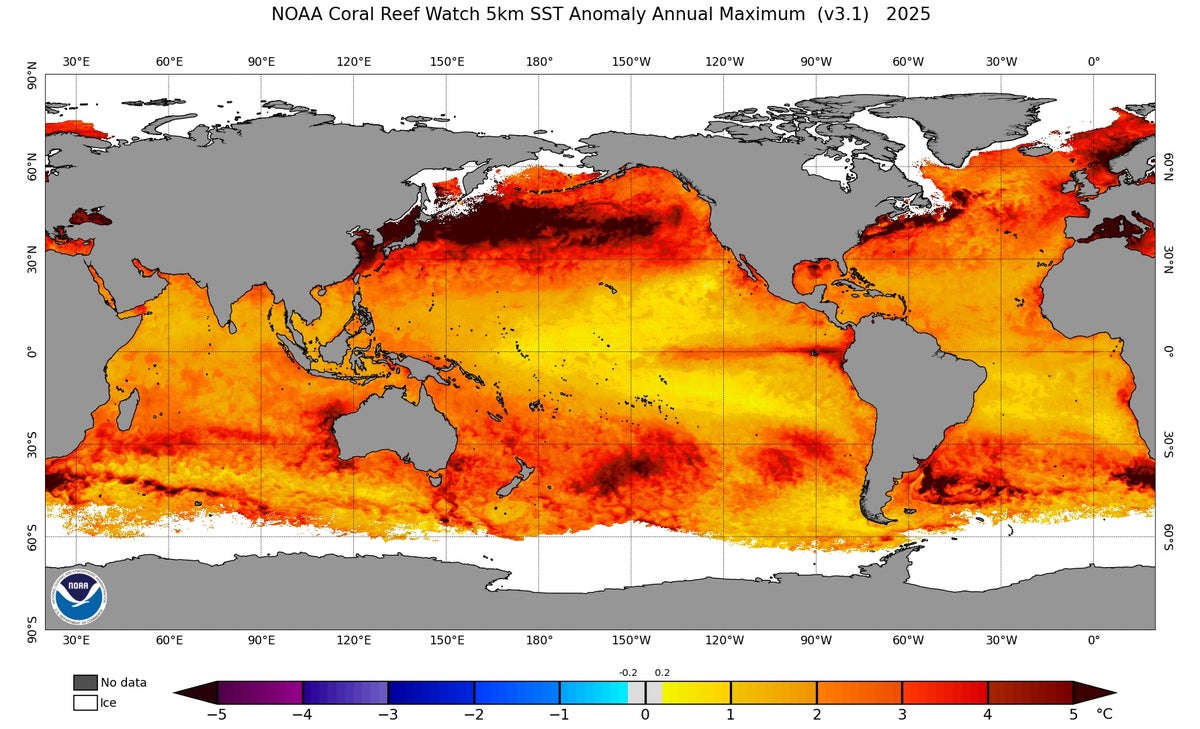
In 2025 the tropical and South Atlantic, North Pacific and Southern Ocean warmed most; the North Atlantic and Mediterranean also warmed, becoming saltier, more acidic and less oxygenated.
Scientists warn ocean heat records will persist while emissions continue; the climate future depends on human choices, requiring rapid emissions cuts to avoid worsening impacts.
Analysis
Analysis unavailable for this viewpoint.
FAQ
The extra 23 zettajoules in 2025 is a large annual increment on top of a long-term warming trend in which the global ocean heat content has been increasing for decades, with scientists estimating a 1961–2022 warming trend of about 0.43 ± 0.08 W/m² that has accelerated in recent decades.
Scientists focus on the top 2,000 meters because this layer holds most of the observed heat gain, is where most temperature measurements exist (especially from the global Argo float network), and dominates interactions with weather, climate, and sea-level rise through thermal expansion.
Warmer oceans provide more energy and moisture to the atmosphere, which can increase the intensity of hurricanes and typhoons and enhance heavy rainfall, leading to greater flooding when storms make landfall.
Rising ocean heat causes seawater to expand, a process known as thermal expansion, which increases global mean sea level independently of added water from melting land ice.
As long as greenhouse gas concentrations stay elevated, Earth retains an energy imbalance in which more heat enters the climate system than leaves, and the oceans absorb most of this excess heat, so ocean heat content will continue to rise and break records until emissions are sharply reduced.