World's Oceans Record Highest Heat Content in 2025
In 2025 the upper 2,000 meters of Earth’s oceans absorbed a record 23 zettajoules of heat, marking the ninth consecutive increase and intensifying climate impacts.

 ARS Technica
The oceans just keep getting hotter

 Gizmodo
The Worldâs Oceans Soaked Up Record-Breaking Heat for the 9th Straight Year

 TIME Magazine
The Oceans Were Hotter Than Ever in 2025
 Scientific American
Ocean Temperatures Just Hit a Dire New Record

 Wired
WiredThe Oceans Just Keep Getting Hotter
Overview
Researchers from over 50 institutions across the US, Europe, and China published analysis in Advances in Atmospheric Sciences finding 2025 ocean heat content rose by 23 zettajoules.
The record 23 zettajoules equals massive energy—researchers liken it to atomic bombs, boiling billions of Olympic pools, and greatly exceeds global annual energy consumption.
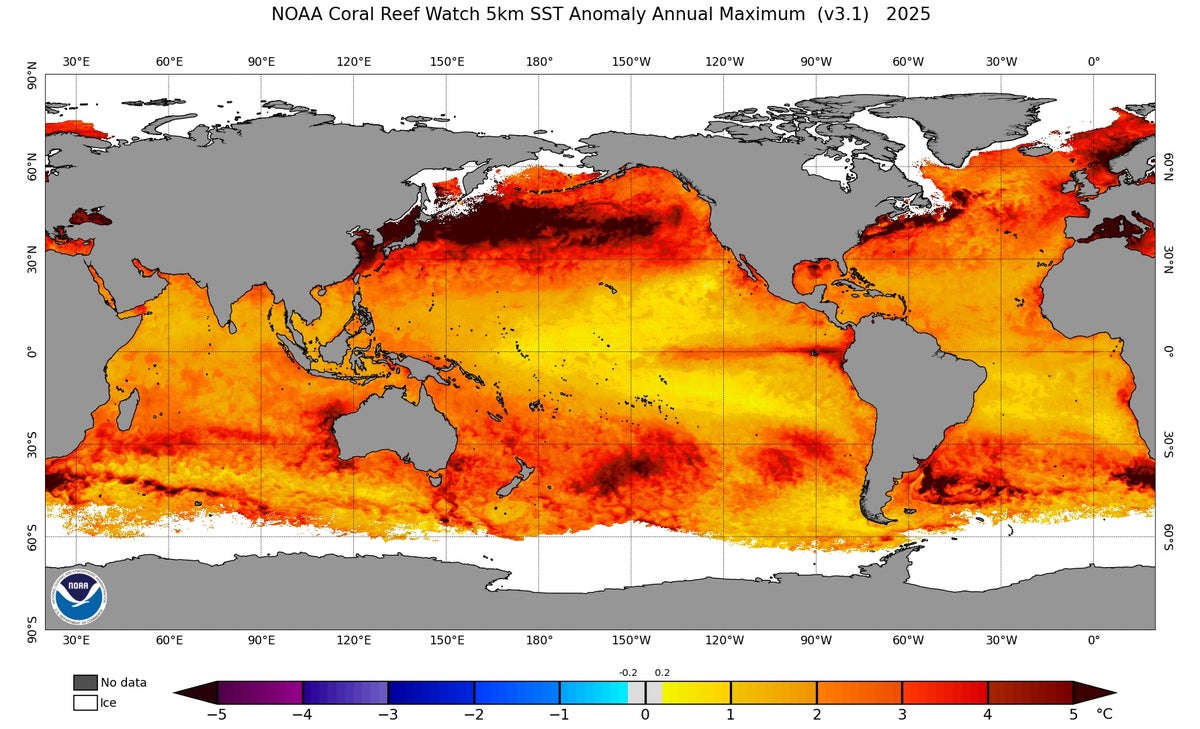
Oceans absorbed more than 90% of planetary excess heat; warming penetrated to 2,000 meters, with notable hot spots in the Southern Ocean, South Atlantic, tropical regions, and North Indian Ocean.
Higher ocean heat content fuels more extreme storms, accelerates ice melt and sea-level rise, and drives coral bleaching and ecosystem destabilization worldwide.
Authors say the record streak will continue until net-zero emissions are achieved; they call for stronger ocean monitoring, better understanding of heat redistribution, and rapid emissions reductions.
Analysis
Center-leaning sources frame the ocean-heat report as an urgent climate crisis, emphasizing human and ecological harms with vivid analogies (Hiroshima-sized bombs), evaluative terms like "catastrophic" and "supercharging", and selective emphasis on extreme events and model certainty; they foreground scientific consensus and adaptation needs while giving little space to uncertainty or trade-offs.
FAQ
Absorbing 23 zettajoules of heat in one year means the upper 2,000 meters of the global ocean stored an enormous amount of additional energy—far more than total annual human energy use—indicating rapid planetary warming concentrated in the seas.
Scientists estimate ocean heat content mainly from in situ temperature profiles collected by instruments such as Argo profiling floats, expendable bathythermographs, and CTD sensors, which provide temperature with depth and allow calculation of stored heat in the upper 2,000 meters.
Warmer oceans provide more energy and moisture to the atmosphere, which can intensify storms, increase rainfall rates, and fuel more powerful tropical cyclones and marine heatwaves.
Rising ocean heat content causes seawater to expand (thermal expansion) and accelerates melting of land ice, both of which add to global sea-level rise.
As long as greenhouse gas emissions keep adding heat-trapping gases to the atmosphere, Earth’s energy imbalance remains positive, so the oceans continue absorbing excess heat and setting new records until emissions are reduced to net zero and that imbalance is stabilized.
