Webb Finds 'Little Red Dots' Are Likely Cloaked, Growing Black Holes
New JWST analyses suggest 'little red dots' are young supermassive black holes concealed in dense ionized gas cocoons, explaining red color and missing X-ray emissions.

 USA TODAY
Webb telescope may have solved mystery of 'little red dots' in space

 The Debrief
James Webb Space Telescope Solves a Cosmic Mystery by Revealing the True Identity of Mysterious "Little Red Dots" in Deep Space
 Scientific American
Mysterious ‘Little Red Dots’ in Space Are Likely Cloaked Black Holes
Overview
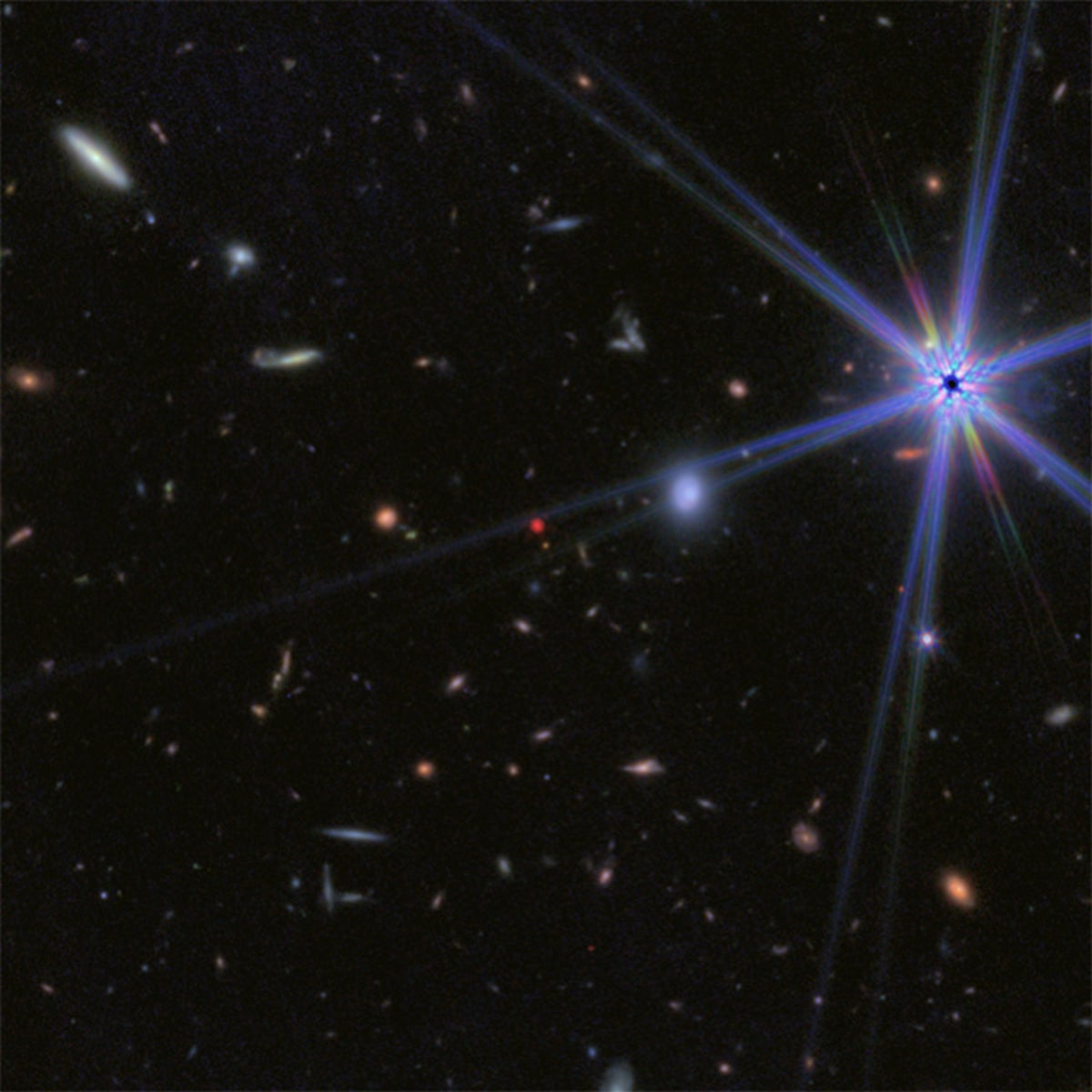
James Webb first detected countless compact 'little red dots' in late 2022—bright red objects seen in the early universe that puzzled astronomers worldwide.
A new Nature study analyzing JWST spectra of a dozen LRDs finds they are likely young supermassive black holes shrouded in dense ionized gas cocoons, hiding typical signatures.
The cocoons trap X-ray and radio emission and scatter ultraviolet into visible red wavelengths, producing the characteristic red color and making objects appear compact and massive.
Correcting for cocoon scattering yields estimated black hole masses roughly between 100,000 and 10 million solar masses, smaller than some earlier interpretations and easier to fit into models.
Researchers stress the sample size is limited; more JWST observations are required to confirm whether all LRDs are cocooned black holes or a heterogeneous population.
Analysis
Center-leaning sources frame the JWST "little red dots" story as a decisive scientific breakthrough, emphasizing resolution of a cosmic mystery. Editorial choices—elevated language ("enigmatic", "solved"), heavy reliance on the University of Copenhagen team and Nature paper, and repeated explanatory quotes—prioritize the research conclusion while offering little skeptical or alternative perspective.
FAQ
Little red dots (LRDs) are compact, bright red objects detected in the early universe, appearing around 600 million years after the Big Bang and declining after 1.5 billion years.
They are young supermassive black holes shrouded in dense ionized gas cocoons that trap X-ray emissions and scatter ultraviolet light into red visible wavelengths.
After correcting for cocoon scattering, black hole masses are estimated between 100,000 and 10 million solar masses, smaller than some prior estimates.
First detected by JWST in late 2022, they appear 0.6 to 1.6 billion years after the Big Bang, peaking around 600 million years post-Big Bang.
The sample size is limited to a dozen LRDs; more JWST observations are needed to confirm if all LRDs are cocooned black holes or a mixed population.