Inside-Out Planetary System Found Around LHS 1903
CHEOPS found four planets around red dwarf LHS 1903 in a rocky-gas-gas-rocky order, prompting a gas-depleted, inside-out formation hypothesis.

 The Debrief
Astronomers Have Discovered an “Inside-Out” Planetary System That's Breaking All the Rules
 Newsmax
Astronomers Puzzle Over 'Inside Out' Planetary System

 Gizmodo
This Bizarre Star System Is Inside Out, and Astronomers Aren't Sure How
 Scientific American
‘Inside-out’ planetary system perplexes astronomers
Overview
On February 6, 2026, researchers led by the University of Warwick reported in Science that CHEOPS observations uncovered four planets around red dwarf LHS 1903, including an unexpected rocky outer world.
The planets orbit a cool red dwarf about 117 light-years away that has roughly half the Sun's mass and about 5% of its luminosity, and the system's order reverses typical rocky-then-gas patterns.
Lead author Dr Thomas Wilson and colleagues ruled out orbit swapping and single giant-impact scenarios through dynamical simulations and proposed sequential, inside-out, gas-depleted formation to explain the arrangement.
The system contains two rocky super-Earths and two gas-rich sub-Neptunes, with the outermost planet measured at 5.8 Earth masses and an estimated temperature of about 60 degrees Celsius.
The authors said future observations with the James Webb Space Telescope and ESA's PLATO mission will help test the gas-depleted formation hypothesis and study atmospheres to refine planet-formation models.
Analysis
Center-leaning sources frame the discovery as an anomalous challenge to established theory by using evocative language (e.g., 'bizarre,' 'strange disorder,' 'runt of the litter'), foregrounding scientists' interpretive claims, and structuring the story to highlight mystery and theoretical implications while offering little skeptical or alternative expert perspective.
FAQ
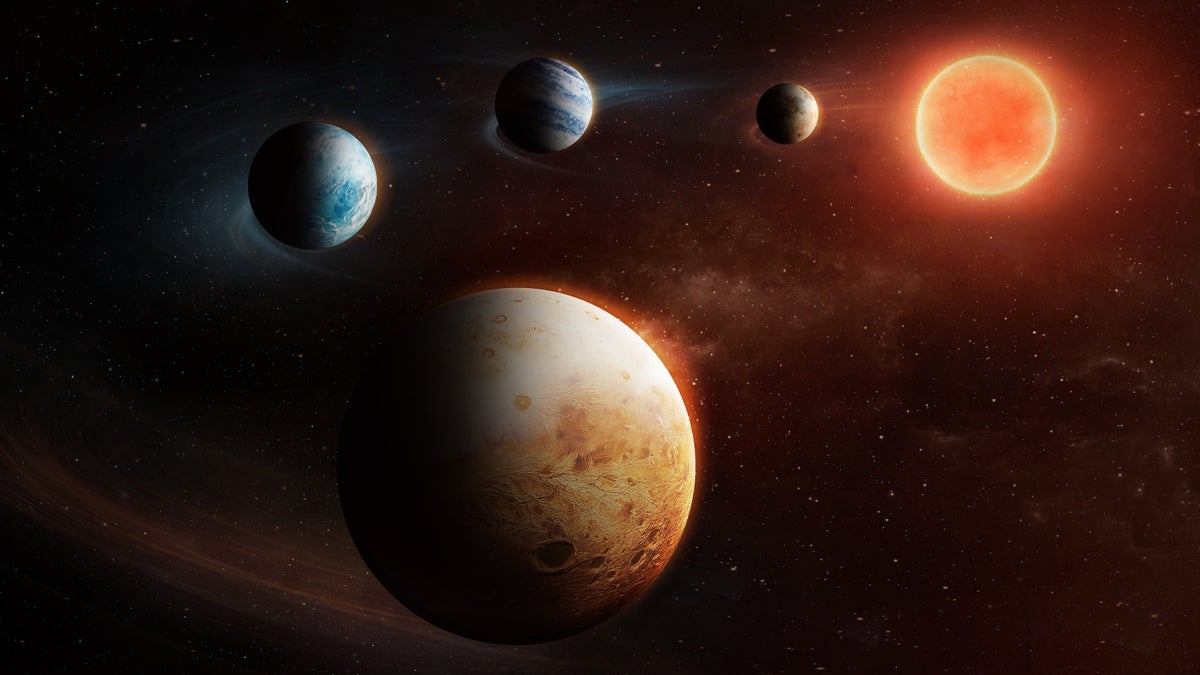
The LHS 1903 system has a reversed planet arrangement that defies conventional patterns. Instead of the typical rocky planets orbiting close to the star and gas giants farther out, LHS 1903 has a rocky planet (b) close to the star, followed by two gas-rich planets (c and d), and then unexpectedly another rocky planet (e) at the outer edge.[1][2] This "inside-out" configuration contradicts the arrangement seen in our own solar system and hundreds of other observed systems, where Jupiter and Saturn orbit far from the Sun while rocky planets like Earth remain closer.[1]
Researchers propose a "gas-depleted" formation mechanism where the four planets formed sequentially from the inside out, rather than all at once.[1][2] The innermost planet formed first when abundant gas and dust were available, but the outermost planet (e) formed millions of years later when much of the protoplanetary disk's gas had already dissipated.[1] This meant insufficient material remained to build a thick gaseous atmosphere, leaving behind only a rocky world.[2] The team ruled out alternative explanations such as planetary migration or a giant impact that stripped away an atmosphere.[3]
The LHS 1903 system provides the first strong observational evidence supporting the gas-depleted planet formation model, which suggests planets can form in environments where gas is scarce rather than abundant.[4] This challenges traditional models that assume all planets form simultaneously with abundant disk material. The discovery also validates a formation mechanism similar to what may have occurred in Earth's solar system during its early history and could explain why some exoplanets appear in unexpected configurations around other stars.[2]
Researchers combined data from multiple telescopes including NASA instruments and the European Space Agency's CHaracterising ExOPlanet Satellite (CHEOPS), along with ground-based telescopes.[1][2] They used transit photometry to detect the planets as they crossed in front of their star and radial velocity measurements to determine their masses.[5] These complementary techniques allowed astronomers to precisely characterize the four planets' orbital periods, sizes, and densities.[5]
Researchers plan to use the James Webb Space Telescope and the European Space Agency's PLATO (PLAnetary Transits and Oscillations) mission to conduct additional observations.[1] These instruments will help test the gas-depleted formation hypothesis more thoroughly and allow scientists to study the atmospheres of the LHS 1903 planets in greater detail, ultimately refining theoretical models of how planets form around different types of stars.[1]