Defunct Van Allen Probe A Set for Uncontrolled Reentry
Probe reentry around 7:45 p.m. ET Tuesday with a 1-in-4,200 casualty risk; NASA granted a waiver after exceeding U.S. debris guidelines and notified the Department of State.

 PJ Media
A 1,300-Pound NASA Satellite Is Falling Back to Earth. What Could Go Wrong?
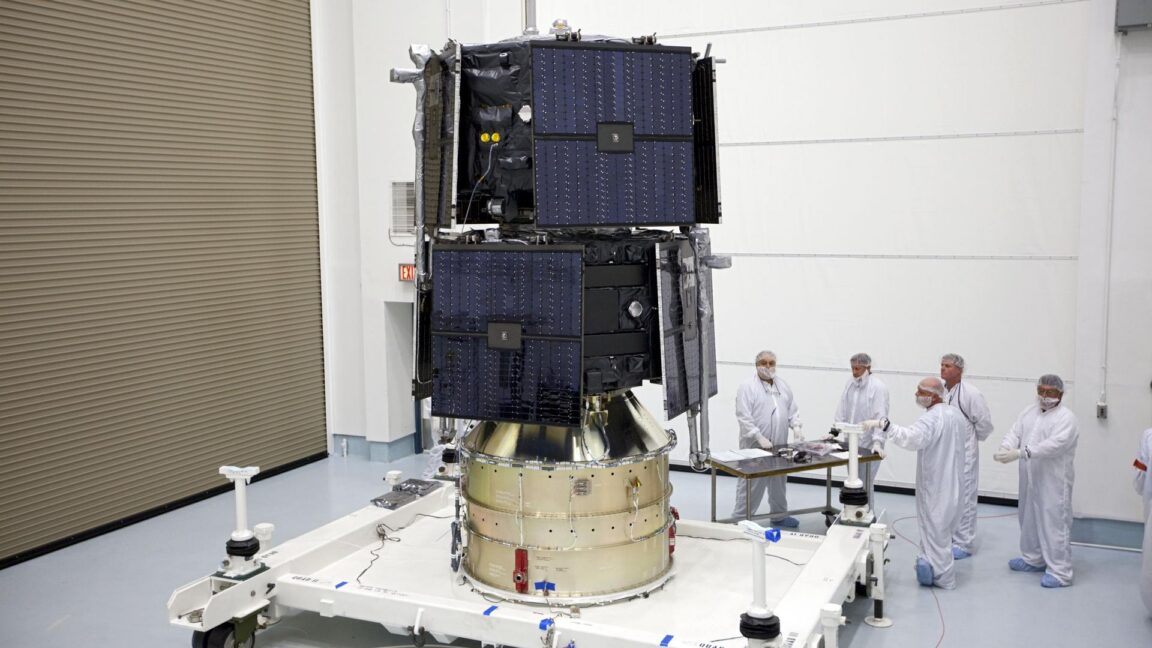
 ARS Technica
Reentry of NASA satellite will exceed the agency's own risk guidelines

 The Gateway Pundit
1,300-Pound NASA Research Satellite Will Come Crashing Down to Earth in the Next Few Hours | The Gateway Pundit | by Paul Serran

 BBC News
A 1,300-pound Nasa spacecraft to re-enter Earth's atmosphere
Overview
The U.S. Space Force predicted the defunct Van Allen Probe A will reenter Earth’s atmosphere around 7:45 p.m. ET on Tuesday, with an uncertainty of plus or minus 24 hours.
NASA said the uncontrolled reentry exceeds U.S. government orbital debris mitigation guidelines, and the agency granted a waiver after weighing the mission’s scientific benefits and the low risk to people.
NASA and the U.S. Space Force said they will monitor the reentry and update predictions, and NASA said it notified the U.S. Department of State about the waiver.
The 1,323-pound (600-kilogram) probe launched on Aug. 30, 2012, ran out of fuel in 2019, and NASA put the odds of harm from surviving debris at about 1 in 4,200, exceeding the 1 in 10,000 standard.
NASA said most of the spacecraft is expected to burn up but that some components may survive reentry, and the probe’s twin, Van Allen Probe B, is not expected to reenter before 2030.
Analysis
Center-leaning sources present the story neutrally, focusing on factual details, quantified risks, and official statements. They report the 1-in-4,200 casualty estimate alongside the 1-in-10,000 standard, quote a NASA spokesperson explaining the waiver, and note uncertainty about reentry timing by citing Space Force predictions.
FAQ
NASA's Van Allen Probes (A and B) were twin spacecraft launched on August 30, 2012, to study Earth's Van Allen radiation belts by measuring particles, magnetic and electric fields, and waves in geospace.
Probe A ran out of fuel in 2019, making controlled deorbit impossible; NASA assessed a casualty risk of 1 in 4,200 from surviving debris, exceeding the 1 in 10,000 guideline, but granted a waiver due to low risk.
Reentry predicted around 7:45 p.m. ET on Tuesday, with uncertainty of plus or minus 24 hours; monitored by U.S. Space Force and NASA.
Discoveries include data on a transient third radiation belt during solar activity, particle energization processes, and long-term measurements of inner belt protons up to ~1 GeV.
Probe B is not expected to reenter before 2030.

