JWST Team Produces Highest-Resolution Dark Matter Map
Nature Astronomy paper presents a JWST dark matter map using nearly 800,000 galaxies and about 1 arcminute angular resolution.





Overview
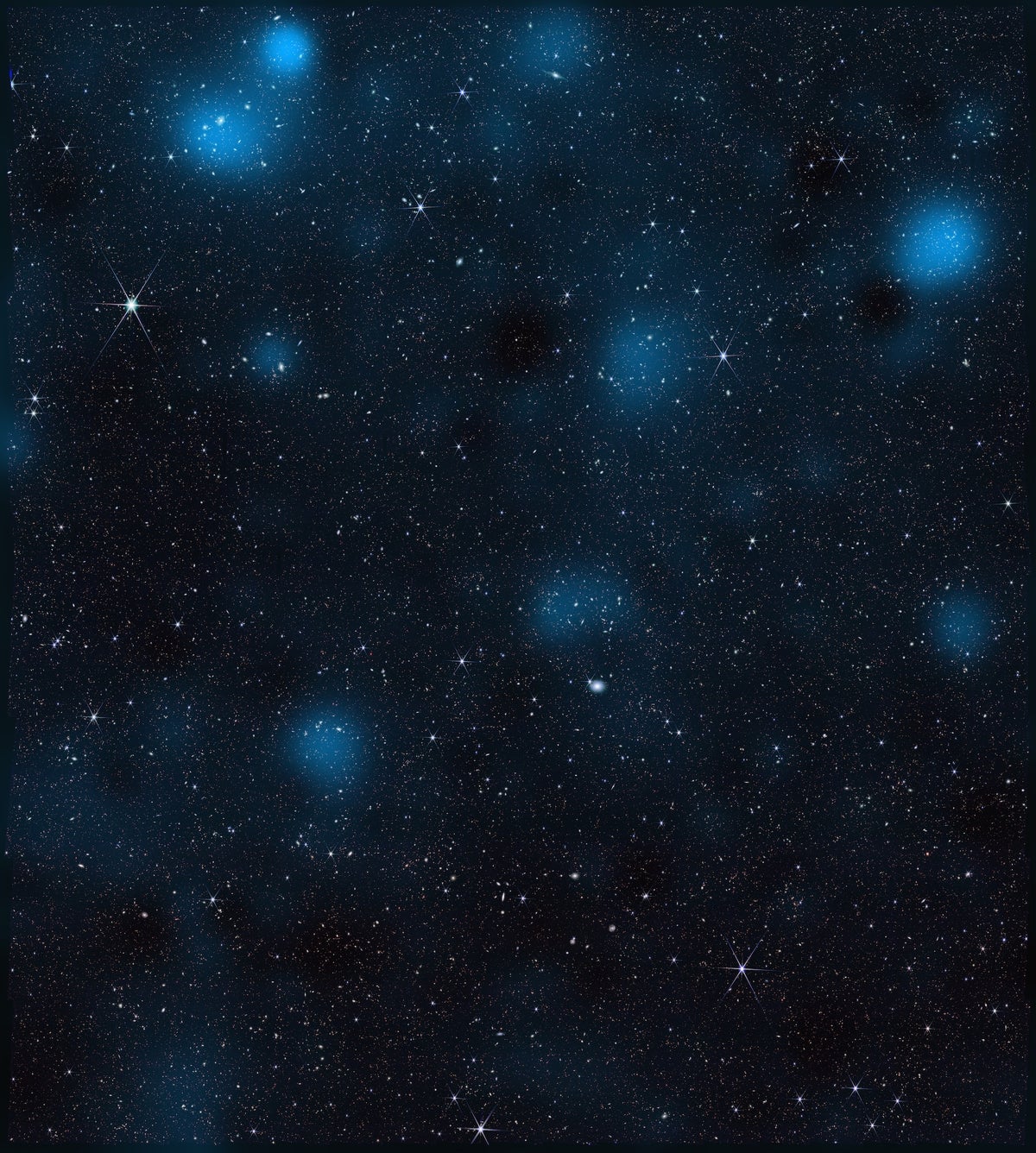
Diana Scognamiglio and colleagues published a high-resolution dark matter map in Nature Astronomy that reconstructs mass distribution from nearly 800,000 galaxies using images from NASA's James Webb Space Telescope, the paper says.
The map achieves roughly 1 arcminute angular resolution and measures about 129 galaxies per square arcminute, giving twice the resolution of previous Hubble-based maps, according to the study.
Diana Scognamiglio, a postdoctoral researcher at NASA's Jet Propulsion Laboratory, said 'Now, we can see everything more clearly' in remarks accompanying the paper, and Catherine Heymans of the University of Edinburgh called the result a way 'to see the invisible,' the authors reported.
The JWST COSMOS-Web field map covers an area about twice the size of the full moon and traces filamentary dark matter structures back to the era of peak galaxy formation about 8 to 11 billion years ago, the researchers write.
The team plans to infer distances to the structures to build three-dimensional maps, and the authors said future surveys with ESA's Euclid and NASA's Nancy Grace Roman Space Telescope will scale the mapping to much larger cosmic volumes.
Analysis
Center-leaning sources present this result as straightforward science reporting, relying on researcher quotes and methodological detail (weak lensing, JWST resolution), avoiding partisan language or policy framing. They note consistency with standard cosmology and future research, and include technical context rather than value‑laden assertions or selective political emphasis.
FAQ
The map uses nearly 800,000 galaxies, achieves roughly 1 arcminute angular resolution, measures about 129 galaxies per square arcminute, and is twice the resolution of previous Hubble-based maps.
The JWST map contains twice as many galaxies as Hubble's (nearly 800,000 vs. previous), has twice the resolution, reveals new dark matter clumps, and provides sharper focus on structures.
Researchers used weak gravitational lensing, observing subtle distortions in light from background galaxies caused by dark matter's gravity, with data from JWST including the MIRI instrument.
The map covers the JWST COSMOS-Web field, about twice the size of the full moon in Sextans, tracing filamentary dark matter structures from 8 to 11 billion years ago during peak galaxy formation.
The team plans to infer distances for 3D maps, with future surveys from ESA's Euclid and NASA's Nancy Grace Roman Space Telescope to expand to larger cosmic volumes.