Nvidia Posts Record Quarter and Year as AI Compute Demand Surges
Nvidia reported roughly $68 billion quarterly revenue and $215.9 billion full-year revenue as CEO Jensen Huang said compute demand is growing exponentially and 'compute is revenue.'

 Gizmodo
'Compute Equals Revenues': Nvidia Needs Jensen Huang's New Catchphrase to Be True
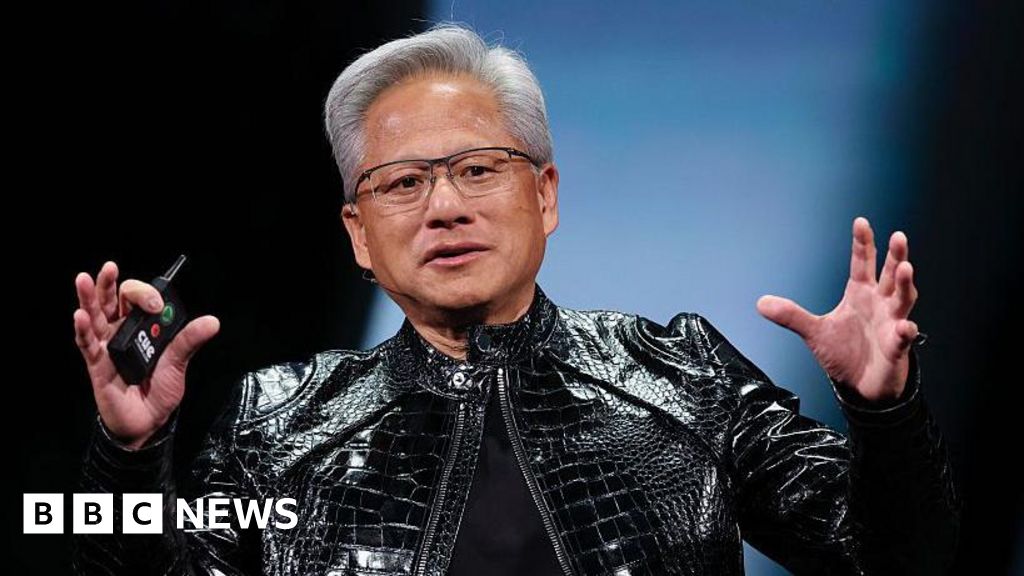
 BBC News
Chip giant Nvidia defies AI concerns with record $215bn revenue

 TechCrunch
Nvidia has another record quarter amid record capex spends | TechCrunch

 Fortune
In Nvidia we trust — ‘The agentic AI inflection point has arrived’ says CEO Jensen Huang | Fortune
Overview
Nvidia reported roughly $68 to $68.1 billion in revenue for the quarter and full-year revenue of $215.9 billion, company results showed.
CEO Jensen Huang said computing demand is growing exponentially and argued that "compute is revenue," linking token generation to cloud and enterprise AI investments.
Nvidia said it is working toward a partnership with OpenAI, but its SEC filings cautioned there is "no assurance" an investment will be completed.
The company's data center business accounted for about $62 billion of quarterly revenue, which Nvidia said included roughly $51 billion in compute and $11 billion in networking.
Nvidia provided guidance implying continued growth, including a forecast of $78 billion for the first quarter of fiscal 2027, company executives said.
Analysis
Center-leaning sources frame Nvidia’s earnings as proof of an unstoppable AI boom by foregrounding huge revenue figures, upbeat CEO quotes, and evaluative words like 'stellar,' 'astounding' and 'skyrocketing.' Editorial choices — headline emphasis, source selection, and quote placement — amplify optimism, while investor worries appear later as quoted, not as primary framing.
FAQ
Nvidia's growth is primarily driven by surging enterprise demand for AI compute infrastructure, particularly for data center services which generated $62.3 billion in Q4 fiscal 2026, up 75% year-over-year[3]. CEO Jensen Huang attributed this to exponential growth in computing demand and skyrocketing enterprise adoption of AI agents[2]. The company forecasts $78 billion in Q1 fiscal 2027 revenue, suggesting continued momentum[2]. However, concerns about sustainability center on whether current investment levels represent genuine AI infrastructure needs or speculative excess, though Huang argues demand fundamentals remain strong rather than bubble-driven[2].
Nvidia unveiled the **Rubin platform**, comprising six new chips designed to deliver up to a **10x reduction in inference token cost** compared to the Blackwell platform[3]. The company also highlighted that Blackwell Ultra delivers up to 50x better performance and 35x lower cost for agentic AI compared with the Hopper platform[3]. These advances address a critical metric in AI economics—the cost per token—which directly impacts the profitability of AI services and enterprise deployment decisions[3].
Nvidia CFO Colette Kress stated the company has "visibility" to **$500 billion in revenue** from Blackwell and Rubin offerings spanning from the start of 2025 through the end of 2026[2]. More broadly, Nvidia believes total AI infrastructure investment could reach **$3 trillion to $4 trillion annually** by 2029 or 2030[2]. This forward visibility suggests management confidence in sustained demand, though it also indicates that current valuations depend on achieving these ambitious infrastructure investment levels[2].
For Q4 fiscal 2026, Nvidia's data center business generated approximately **$62.3 billion in quarterly revenue**, comprising roughly **$51 billion in compute and $11 billion in networking**[3]. Full-year data center revenue reached $193.7 billion, up 68% year-over-year[3]. This breakdown shows that GPU compute chips represent the dominant revenue driver, while networking infrastructure (interconnects) plays an important but secondary role in the company's AI business model[3].
During fiscal 2026, Nvidia returned **$41.1 billion to shareholders** through share repurchases and cash dividends[3]. This capital return strategy, executed while the company continues aggressive investment in product development and manufacturing, reflects management confidence in earnings sustainability and a balanced approach to deploying exceptional free cash flow[3].
