Huckabee Remarks on Israel Ignite Regional Condemnation
Mike Huckabee's remark that 'it would be fine if they took it all' drew condemnation from more than a dozen Arab and Muslim governments and an embassy claim the quote was taken out of context.

 Joe.My.God.
14 Arab And Muslim Nations Condemn Huckabee's Claim Israel Has "Biblical Right" To Entire Middle East - Joe.My.God.

 Mother Jones
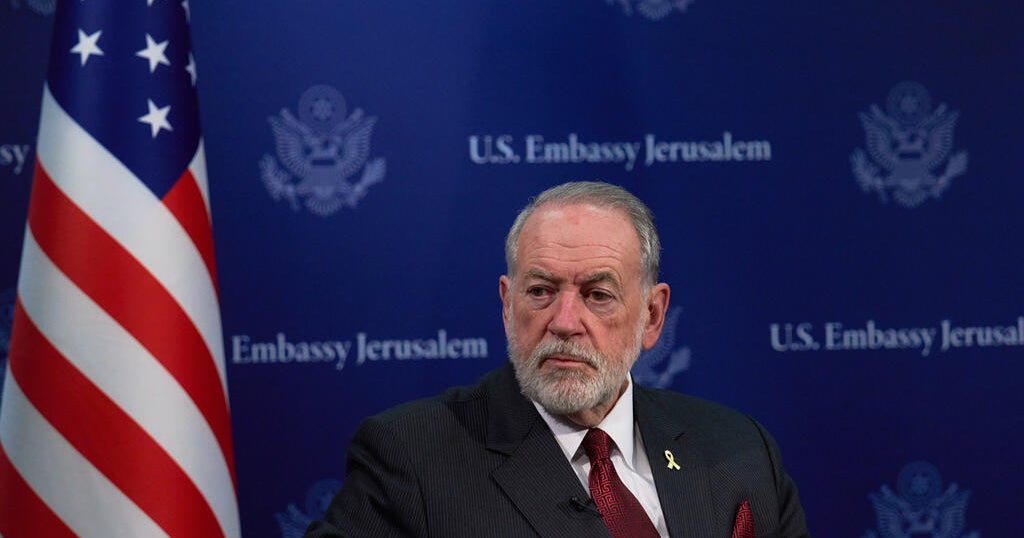
US Ambassador to Israel: “It would be fine” if Israel took over most of the Middle East
 CBS News
U.S ambassador's comments on Israel and the Middle East were taken out of context, embassy says

 Al Jazeera
US envoy Huckabee tries to deny saying he would support Israel expansionism
Overview
U.S. Ambassador Mike Huckabee said in an interview released on Friday, "It would be fine if they took it all," an assertion that has provoked widespread objections.
A joint statement by Egypt, Saudi Arabia, Jordan, Bahrain, the United Arab Emirates, Qatar, Indonesia, Pakistan, Turkey, Syria, Kuwait, Lebanon, Oman and the Palestinian territories called Huckabee's remarks "dangerous and inflammatory."
A U.S. Embassy spokesperson said Huckabee's comments were taken out of context.
Israel has roughly 160 settlements housing about 700,000 Jews in the West Bank and East Jerusalem, where some 3.3 million Palestinians live alongside them.
Rights advocate Raed Jarrar urged Huckabee's immediate removal, warning that the Trump administration's failure to act "will be read by the world as an endorsement of his views."
Analysis
Center-leaning sources frame Huckabee's remarks as diplomatically reckless by foregrounding regional condemnation, legal and historical context, and political contrast with official U.S. policy. Editorial choices—sensational headlines (e.g., “Outcry”), selective placement of Arab governments’ “dangerous and inflammatory” language, and settlement background—collectively emphasize controversy over Huckabee’s clarifications.
FAQ
Huckabee made the remark during an interview with commentator Tucker Carlson about Israel's geographical borders. Carlson referenced biblical interpretations from the Book of Genesis, suggesting God promised Abraham's descendants land from the Nile to the Euphrates—encompassing Israel, Jordan, Syria, Lebanon, parts of Saudi Arabia, and Iraq. When asked if Israel had a right to that land, Huckabee responded with the contested phrase. However, he subsequently clarified that Israel was not actually seeking to expand its territory and has a right to security in lands it legitimately holds.
A coalition of 14 Arab and Islamic countries issued a joint statement condemning the remarks: Qatar, Egypt, Jordan, the United Arab Emirates, Indonesia, Pakistan, Turkey, Saudi Arabia, Kuwait, Oman, Bahrain, Lebanon, Syria, and Palestine. Additionally, the Gulf Cooperation Council, the Organisation of Islamic Cooperation (OIC), and the Arab League issued separate condemnations, describing the remarks as extremist, provocative, dangerous, and inflammatory.
Israel has approximately 160 settlements in the West Bank and East Jerusalem housing roughly 700,000 Jews, alongside approximately 3.3 million Palestinians living in the same territories.[1] Under the current ceasefire agreement with Hamas, Israel has withdrawn troops to a buffer zone but still controls more than half of Gaza's territory, with further withdrawals required under the ceasefire deal though no timeline has been specified.[2]
A U.S. Embassy spokesperson stated that Huckabee's comments were taken out of context.[1] Saudi Arabia's Foreign Ministry called for the U.S. State Department to clarify its official position on the remarks, and multiple Arab and Islamic states urged the United States to reaffirm its commitment to international law and the two-state solution.
Huckabee, a former Arkansas governor who twice ran for president, has long opposed the idea of a two-state solution for Israel and Palestinians.[2]