U.S. Strikes Iranian Drone Carrier, Shifts to Dismantle Missile Industry
CENTCOM says over 30 Iranian vessels have been sunk or destroyed and U.S. bombers struck nearly 200 targets as Operation Epic Fury moves to disable Iran's missile production capability.

 FOX News
Operation Epic Fury destroys Iran's navy and cuts missile attacks by 90% in ongoing campaign
 Townhall
CENTCOM: U.S. Has Destroyed More Than 30 Iranian Ships
 Washington Free Beacon
Iranian Ballistic Missile Fire Down 90 Percent Since Start of Operation Epic Fury, Pentagon Says

 The Gateway Pundit
Iranian Drone Carrier the Size of a WWII Aircraft Carrier BURSTS INTO FLAMES After Direct Hit by U.S. Forces | The Gateway Pundit | by Jim Hᴏft
Overview
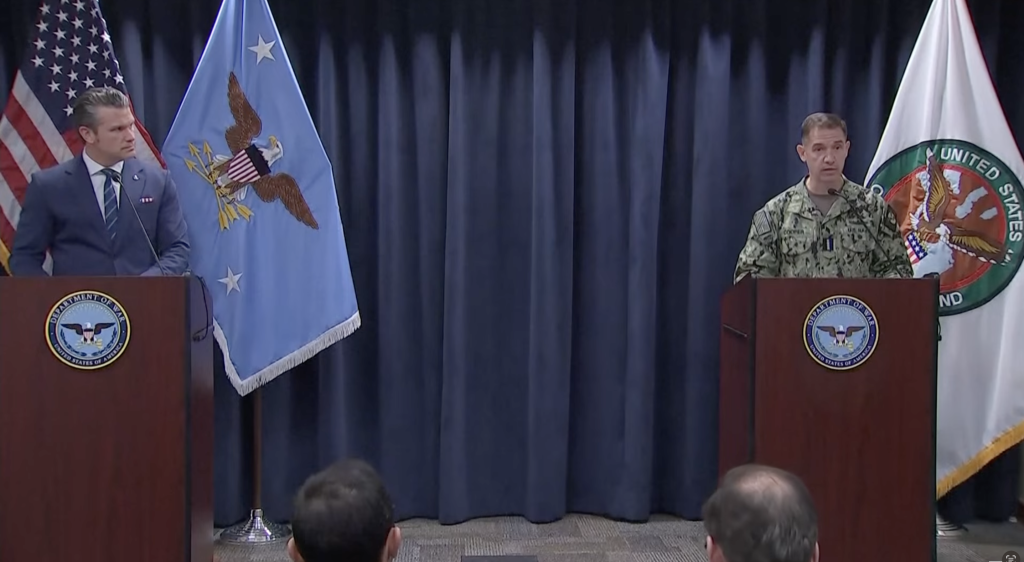
Adm. Brad Cooper said Thursday U.S. forces struck an Iranian drone carrier roughly the size of a World War II aircraft carrier and that the ship is on fire.
They said the strikes are part of Operation Epic Fury and that U.S. forces have sunk or destroyed over 30 Iranian vessels.
Defense Secretary Pete Hegseth said the U.S. can "sustain the fight for as long as it takes" and announced a U.S. torpedo sank an Iranian warship, the first such sinking since World War II.
Cooper said U.S. bombers struck nearly 200 targets in the last 72 hours and that B-2 bombers dropped dozens of 2,000-pound penetrators on buried ballistic missile launchers.
Cooper said the operation will now focus on "systemically dismantling" Iran's missile production to "destroy their ability to rebuild," and Hegseth said more forces and munitions are still coming.
Analysis
Center-leaning sources frame the story as decisive U.S. military success by foregrounding senior commanders’ triumphant language, emphasizing strike counts and destroyed assets, and omitting opposing perspectives or independent verification. Editorial choices — selective quotations, vivid imagery ('on fire') and lack of Iranian or civilian viewpoints — produce a one-sided, militarily affirmative narrative.
FAQ
Operation Epic Fury aims to dismantle the Iranian regime's security apparatus and military capabilities. Initial targets included Islamic Revolutionary Guard Corps command and control facilities, Iranian air defense capabilities, missile and drone launch sites, and military airfields.[1] The operation has now shifted to systematically dismantling Iran's missile production infrastructure to destroy their ability to rebuild.[1] According to military leadership, the operation involves the largest regional concentration of American military firepower in a generation.[1]
In the first 24 hours of Operation Epic Fury, U.S. and partner forces struck more than 1,000 targets across Iran in a single synchronized wave described as a "massive overwhelming attack."[2] The operation employed precision munitions launched from air, land, and sea, and marked the first time CENTCOM's Task Force Scorpion Strike employed low-cost one-way attack drones in combat.[1] Within 72 hours, U.S. bombers struck nearly 200 additional targets, including buried ballistic missile launchers hit by B-2 bombers with 2,000-pound penetrators.
U.S. forces have sunk or destroyed over 30 Iranian vessels during Operation Epic Fury. Notable targets include an Iranian drone carrier roughly the size of a World War II aircraft carrier that was struck and set on fire, and an Iranian warship sunk by a U.S. torpedo—the first such naval sinking since World War II, according to Defense Secretary Pete Hegseth.
According to CENTCOM, there have been no reports of U.S. casualties or combat-related injuries during Operation Epic Fury. Following the initial wave of U.S. and partner strikes, CENTCOM forces successfully defended against hundreds of Iranian missile and drone attacks, with minimal damage to U.S. installations that has not impacted operations.[1]
Yes, Defense Secretary Pete Hegseth stated that the U.S. can "sustain the fight for as long as it takes" and announced that more forces and munitions are still being deployed to support Operation Epic Fury. The operation's focus on systematically dismantling Iran's missile production capability indicates the military campaign will continue beyond the initial strikes.
