Trump Says U.S. Will Secure Strait Of Hormuz Alone After Allies Decline
Trump said the U.S. no longer needs allied help to secure the Strait of Hormuz after allies declined; oil prices rose and U.S. strikes targeted Iranian missile sites near the strait.

 Raw Story
Trump just got a 'quiet but unmistakable' message with a deafening silence: expert

 MS NOW
Opinion | Why Trump can’t get other countries to help him reopen the Strait of Hormuz
 NBC News
Rebuffed by allies, Trump now says U.S. doesn't need help defending the Strait of Hormuz

 Joe.My.God.
Trump: I Don't Need Congress To Withdraw From NATO - Joe.My.God.
Overview
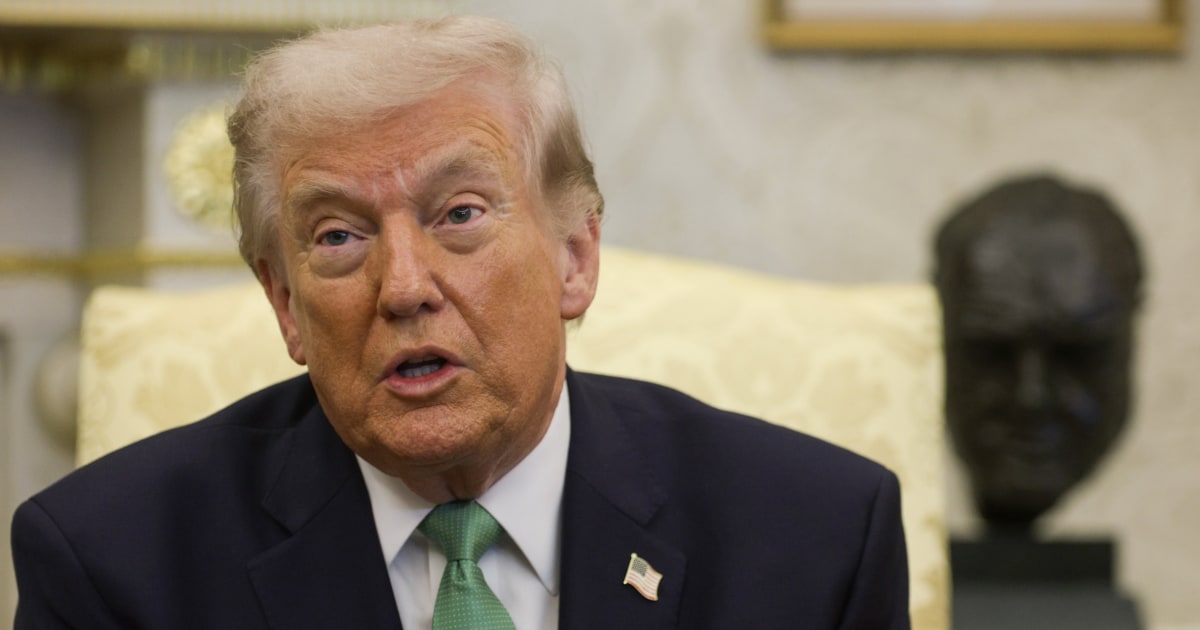
President Donald Trump said the United States "doesn't need any help" securing the Strait of Hormuz during an Oval Office meeting with Irish Prime Minister Micheál Martin.
Trump launched appeals for a coalition to escort tankers after the U.S. and Israel attacked Iran on Feb. 28, which has disrupted ship movements and global oil supplies.
Germany's defense minister Boris Pistorius said "This is not our war," and French President Emmanuel Macron said France would "never take part" in operations to reopen the strait in the current context.
Brent rose to $103.42 per barrel and U.S. oil to $96.21, while roughly 13 million barrels per day passed through the strait in 2025, representing about 31% of seaborne crude flows.
A State Department cable directed diplomats to press foreign governments to designate the IRGC and Hezbollah as terrorist organizations, while U.S. forces have struck Iranian missile sites near the strait.
Analysis
Center-leaning sources frame this coverage as a critique of U.S. pressure, foregrounding EU caution through selective quotations and emphasis. Editorial choices—calling the action a 'war launched by the U.S. and Israel,' leading with EU rejection, and centering EU officials while omitting military planners and affected commercial actors—steer readers toward skepticism about troop deployments.
FAQ
Germany's defense minister Boris Pistorius stated 'This is not our war,' and French President Emmanuel Macron said France would 'never take part' in operations to reopen the strait in the current context. The European Union has ruled out expanding its naval mission.
Roughly 13 million barrels per day passed through the strait in 2025, representing about 31% of seaborne crude flows. Disruptions have caused Brent oil to rise to $103.42 per barrel and U.S. oil to $96.21.
The U.S. and Israel attacked Iran on Feb. 28, disrupting ship movements. U.S. forces have struck Iranian missile sites near the strait. Recent vessel attacks include strikes on SKYLIGHT, MKD VYOM, and SEA LA DONNA.
The Joint Maritime Information Center (JMIC) assesses the regional maritime threat as CRITICAL (an attack is almost inevitable) following confirmed missile strikes on merchant vessels. Risk Intelligence describes it as 'effectively closed' by Iranian behavior and enforcement.
Conduct pre-voyage risk assessments, monitor VHF Channel 16, activate Ship Security Alert System if attacked, keep distance from warships and energy sites, and report to U.S. Fifth Fleet and UKMTO. Treat as potential mine hazard.